
Collisions with Reality
By Kara Lilly, CFA and Michael Kosmalski, CFA
In recent weeks, yields on Treasury bonds climbed to 4.74% on the 10-year and 5.37% on the 30-year. These levels, not seen in 19 years, come amid substantial turbulence in the bulwark asset and linchpin of the global financial system. They also coincide with America crossing an ill-boding milestone: surpassing $40 trillion in national debt.
Even equity investors who might otherwise slip into the daze of late-summer doldrums and tech-hype complacency cannot look away now. Yields like these augur considerable pain ahead if they are not tempered soon.
More than this, though, their emergence is a sign of a truth we spoke to back in May, in our piece What Can the U.S. Do to Clean Up Its Debt?, and one investors have largely ignored in recent years:
There is no escaping economic gravity.
Run from it, avoid it, resist it, but the bill always comes due. Economic gravity overwhelms all else in the end. As much as human nature compels us to avoid painful realities, some forces are as inescapable as mortality itself. And while hopeful thinking and Band-Aid solutions may buy time, when enough pressure has built, there is eventually nothing for it but to face the mess.
We appear close to there with American debt.
Why are yields rising?
Let’s begin with a quick tour of the facts. Treasury bonds have been on a rollercoaster trajectory of ups and downs this summer, but the overall direction has been steadily higher.
Fears around persistent inflation appear at least partially to blame. War in the Middle East rages on, with no immediate end in sight to the conflict, or to the elevated energy and input prices that naturally come with such disruptions. Oil tankers still barely pass through the Strait of Hormuz.
Also to blame is uncertainty around the future path of American monetary policy. Although our team overall agrees with many of the guiding goals of the new Fed Chair, Kevin Warsh—for instance, the importance of a smaller balance sheet—the investment community has struggled to digest the Federal Reserve’s new guidance practices. Warsh is like a judge ordering the investment community into rehab for its addiction to dot plots, bloated balance sheets and ultra-low rates. Markets so far don’t like the withdrawal.
There is also more competition in financial markets, in general, for capital. When the stock market has soared as much as it has in recent years, who really wants to allocate their portfolios heavily to bonds? Who wants to own Treasuries when far sexier hyperscalers are issuing higher-yielding bonds to finance their mega projects? In a world obfuscated by tariff threats and questions of sovereignty, how many friends want to buy America?
An argument can be made that a certain degree of crowding out is now occurring in bonds, what with the massive capital issuances coming to market and what has been a heavy risk-on mood in equity markets.
There are also those who believe that investing in bonds is ultimately still a matter of creditworthiness. Many bond investors may simply be questioning the wisdom of lending ever greater sums to a country whose debt burden continues to grow. And therein lies the danger: as yields climb, the cost of servicing that debt rises with them, creating a negative feedback loop that only compounds the underlying problem.
So, Treasury rates have risen. They have gotten to a point where they are undeniably bad news. Bond investors know it. Equity investors are waking up to the reality. Even American leaders, with their heads stuck firmly in the sand for so long, can no longer deny it, as evidenced by recent actions taken by the Treasury (more on this below).
The question is, what will they do?
America tries a gateway drug
Regular readers may now recall our take in What Can the U.S. Do to Clean Up Its Debt? Back then, we argued that all countries, no matter how great, no matter how hegemonic, must ultimately face their debt mountains. The British did so after the Napoleonic Wars and the Industrial Revolution. The U.S. did it once after World War II. A country that has amassed too much debt eventually faces a mathematical reality, that interest compounds on itself. It can then either face the problem willingly, and with some integrity, or eventually meet a reckoning.
There are certain levers a country can pull. Some work by increasing the country’s capacity to carry the debt (i.e., grow out of the problem). Others work by reducing the burden itself, through spending cuts, higher taxes, inflation, financial repression or, in more extreme cases, restructuring or default.
Most countries that avoid a reckoning do so by pulling on a coordinated mixture of these levers. Some degree of fiscal common sense is typically part of the mix: spend less, tax more, or at the very least cease adding to the problem. However, as we said in our piece, common sense requires political will. American leadership appears to have little appetite for outdated notions of financial responsibility. Back then, we argued that this administration would therefore be more likely to experiment with regimes that shift some of the burden onto investors, including financial repression or capital controls.
This now appears to be the road the Americans are taking.
At the beginning of August, the U.S. joined Japan in an extraordinary intervention to support a falling yen. This was the first coordinated action of its kind since 2011.
Bessent directed the Treasury to sell euros—catching European partners totally off-guard—to buy the yen. He then encouraged Japan to make greater use of the Federal Reserve’s FIMA facility, which allows foreign governments to borrow dollars against their Treasury holdings rather than sell those bonds into the market.
Why would he take such unusual actions? Because he was afraid of rising Treasury yields. Japan owns more than $1 trillion of U.S. Treasuries, and any large-scale selling would add supply to an already strained market, pushing yields higher.
Then, less than three weeks later, the Treasury intervened more directly in the bond market, doubling the size of its planned buybacks of longer-dated government debt from $2 billion to $4 billion per operation. Now, officially, this program is intended to improve liquidity. But anyone with eyes could see the Treasury was stepping in as a larger buyer of its own bonds out of fear. They were trying to drive yields down.
In other words, the Americans have been quietly dabbling with what is, in effect, a gateway drug. They are experimenting with financial repression. And like other gateway drugs, the more comfortable they become with interventions like this, the more emboldened they may feel to experiment with “harder” financial repression policies later. Policies, for example, that could include mandating banks or insurance companies to hold higher levels of Treasury bonds. These would have their own suite of unintended and unpredictable consequences.
This week, Bessent raised the possibility of significantly expanding these purchases.
When an unstoppable force meets an immovable object
In psychology, avoidance is a coping habit in which one runs from hard thoughts, feelings or situations. An inescapable collision happens when the truth you have tried to dodge for so long finally catches up with you and forces a reckoning with reality.
We are not saying that “now” is the eventual American debt reckoning. It could be. More likely, however, American leadership will continue to do what it has been doing: kick the can down the road, apply a Band-Aid, then kick the can a little farther. They do not seem prepared to deal with the issue in any responsible or coordinated manner. The stomach isn’t there for it.
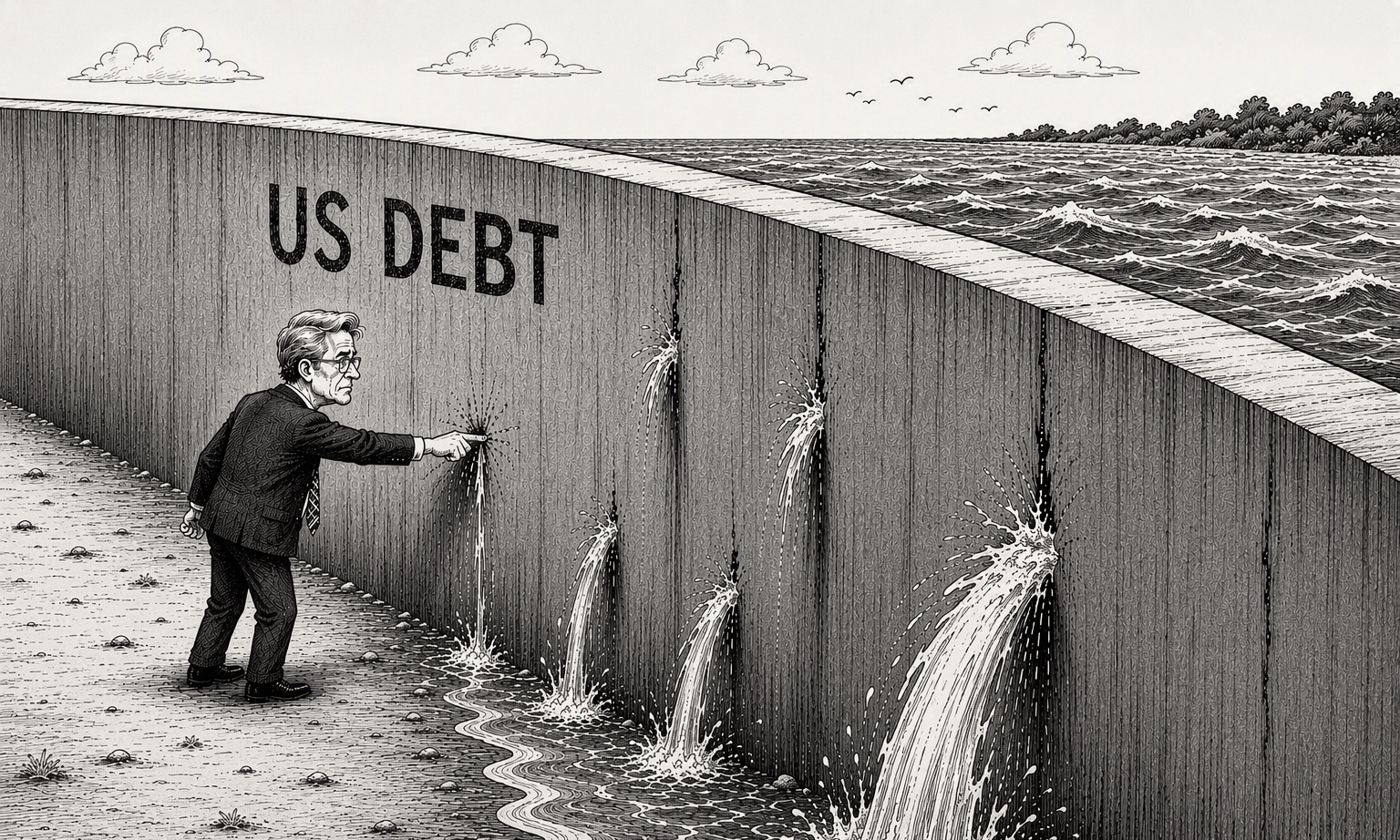
That said, real cracks and lines of fissure are starting to show under the pressure. The national debt has already crossed $40 trillion, and at this scale even small changes in interest rates carry enormous consequences. According to the Congressional Budget Office, if Treasury rates were just 10 basis points higher than forecast, the U.S. could face roughly $351 billion in additional deficits over the following decade, largely from higher borrowing costs. This gives us some sense of just how consequential a 50-basis-point move, like the one we have seen, can be. The arithmetic quickly becomes ugly.
From an investment standpoint, higher yields are also not without consequence. Even with global appetite for them moderating, Treasuries still set the effective risk-free rate. All other risk assets are priced against them. When Treasury yields rise, the cost of capital across the economy rises with them, changing the price investors are willing to pay for risk.
A higher risk-free rate pulls equity valuations downward. Future earnings are worth less in today’s dollars, bonds become more competitive with stocks, and the hurdle for taking risk rises.
In the real economy, mortgages and corporate borrowing become more expensive. Heavily indebted companies become more exposed as their own debt rolls over.
The knock-on effects are large.
For the investor, so used to ignoring bonds in favour of the more alluring world of stocks, recent events are an important wake-up call. There is at least one other major force at work, potentially just as consequential for medium-term investment outcomes as artificial intelligence: governments, especially the U.S., sitting on enormous piles of debt.
Something will eventually have to be done about this. The question is not whether the debt will impose a cost, but how that cost will be borne: through fiscal restraint, stronger growth, inflation, higher taxes, financial repression, or some combination of them. How disruptive that process becomes depends greatly on how long American leaders wait before confronting it.
The bill always comes due.