
Reconsidering the Luddite
By Kara Lilly, CFA and Ted Conrod, CFA
The CEO of Goldman Sachs, David Solomon, wrote an opinion piece in the New York Times earlier this year. In case you missed it, his argument went something like this: concerns over what artificial intelligence (AI) will do to the labour market are overblown, revolutionary technologies always create net new jobs, and the American economy is adaptable.
In short, nothing to see here, nothing to fear.
Mr. Solomon, age 64, who took home $47 million in pay in 2025 alone, probably does not have much to fear from AI. With a net worth estimated somewhere between $100 and $250 million, and a leadership tenure as senior as it comes, he should be well insulated from its effects. Should the worst fears around this technology come true, one assumes his portfolio of assets will readily shield his loved ones from chaos. Frankly, even in that scenario, as a large owner of capital, he should stand to benefit from AI’s advances.
Mr. Solomon’s article, which argues that AI will be “a great leap forward for society,” contains many good points, informed by reason and history. Where he misses, however, is in a tone at times strident around the coming dislocations, which he acknowledges will be real even as he breezes past them.
As long-term investors, however, how people feel about artificial intelligence is a practical matter that goes beyond social commentary. In a democratic society, the rules of capitalism are ultimately governed by a carefully guarded social contract: a quietly held mix of explicit and implicit agreements that define what people will or will not accept from enterprise, what they want regulated, and who they believe should be taxed and how. Most of the time, this social contract lies hidden. Yet there are moments when it returns to the forefront. In those moments, it is fragile.
When considering the future impacts of artificial intelligence, it is important to consider not only economic disruption, but also the related social and political consequences. Business does not happen in a vacuum, and these things have a way of circling back to the rules of enterprise.
So, with this in mind, let’s review where Mr. Solomon is probably right, and where he may be underestimating risk.
It is perhaps time to reconsider “the Luddite.”
What he gets right
First, where we believe he gets it mostly right: Mr. Solomon argues, correctly, that AI will almost certainly reshape our everyday lives. Goldman Sachs’s own economists estimate that AI will automate around 25 percent of current work hours. For context, this is a mid to lower-end prediction of the possible disruption to labour. Other institutions, like Anthropic (the AI company that developed Claude), think the number could be far higher.
Mr. Solomon then goes on to note, again correctly in our view, that human ingenuity is typically underestimated. In most historical antecedents to this one, there were serious challenges, but society nevertheless created net new jobs in response to disruption. He cites electrification in the 1900s and the digital revolution in the 1990s as two periods when fears of displacement were overblown and society broadly benefited from the new technologies. In each case, industry became more productive and initial fears were ultimately allayed.
We also agree that it is unwise to bet against human creativity. Historically, human ingenuity in the face of constraints has been consistently miscalculated. With artificial intelligence, it is impossible to know in advance all the ways people will innovate with the technology. But we do anticipate that what is coming soon will be a marvel to behold.
What is less convincing
Where his argument may be weaker is in the apparent assumption that the transition will be manageable, and that cognition and the labour market will be largely augmented by artificial intelligence rather than directly replaced. Those are big assumptions.
Regarding augmentation, Mr. Solomon writes:
“When I was a first-year banking analyst, something as simple as making a graph of a stock’s performance took six hours of looking up prices in back issues of The Wall Street Journal on microfiche. Today, a first-year analyst can do it in seconds, and we have employed more people than ever in recent years. With more sophisticated tools, the complexity of our work naturally expands. Do any of us feel like we have less to do these days despite the convenience of Excel, email or Zoom?”
Really? Is he really comparing what could be the single most important technology for cognition in history to an Excel spreadsheet?
Here, the argument is less convincing. In our own business, many tasks that would previously have taken weeks for an eager junior analyst to perform can now be handled with a few fairly simple AI prompts.
Further, Mr. Solomon demonstrates remarkable confidence on the subject of labour disruption. If society readily absorbs the shock from this revolution without major upheaval or unrest, that would be a promising result indeed. But that future is by no means guaranteed. What is different about this technology, compared with historical antecedents, is the scale and speed at which it is unfolding. The rate at which artificial intelligence is being implemented is far faster than previous technological revolutions. Frankly, it is incredible what these tools can do, and how quickly they are improving.
And on the subject of dislocation: unlike what Mr. Solomon suggests, when we hear CEOs speak of artificial intelligence, it is rarely only about augmentation. Couched in diplomatically phrased language is often a message about layoffs and hiring freezes. In short, there will probably be a gap between when people lose their jobs and when new ones are invented. That gap could create real pain, and will not be easily solved. Just ask the middle-aged auto workers in Michigan how easy it is to retool, and how effective government programs are in helping that happen.
Confidence that all of this can be handled smoothly by existing governments seems, to us, naïve.
Reconsidering the Luddite
This is where it pays to consider the Luddite, though not in the way one might think.
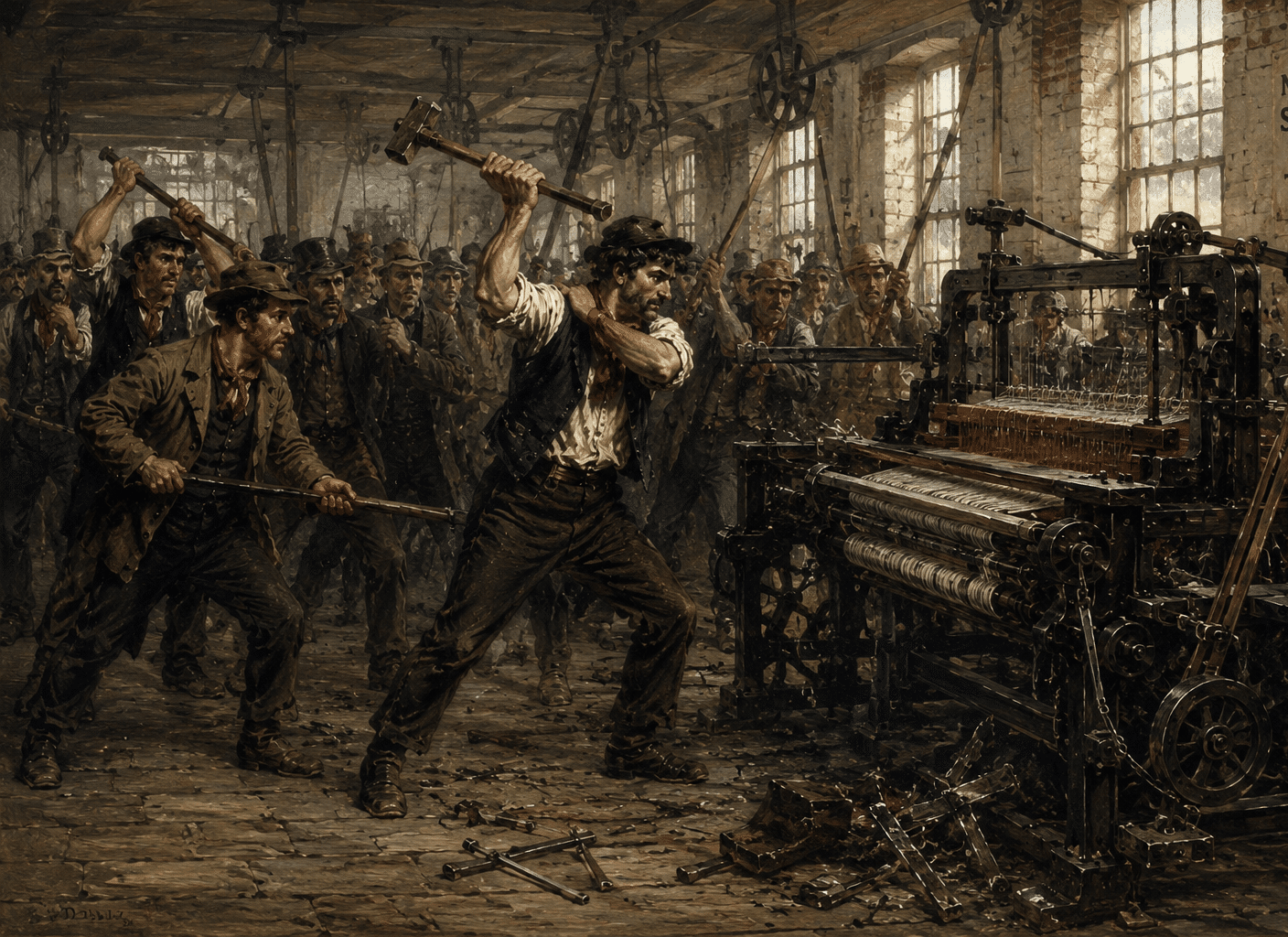
These days, the word “luddite” is used to describe a person who is ignorant of technology and progress. However, contrary to popular modern myth, the original Luddites were not stupid or mindless. They were early 19th-century English textile workers, skilled artisans who protested automated machinery during the Industrial Revolution because it was destroying their livelihoods. They went on strike, vandalized machines, and did what they could to draw public attention to their cause.
In modern times, this movement is viewed with condescension and derision. To be a Luddite is to be the butt of a joke. But ask yourself: if you had a skilled job and lost it to a machine, what democratically available tools would you deploy to preserve your ability to provide for your family?
Reconsidered through a more human lens, perhaps the Luddites were less irrational than they are often made out to be.
Moreover, a more empathetic understanding of their plight may help us better predict what is coming next. The Luddites remind us that there can be hard economic consequences to something as soft as the human experience. Social unrest is costly to established structures. Just ask the French. Or, in more recent times, look to the rise of populism worldwide, which ascended not coincidentally alongside rising wealth inequality. Recall that the MAGA movement was, in part, sparked by the purported loss of 2-3 million US manufacturing jobs due to the “China shock”. It is not inconceivable to imagine the loss of many more millions of white-collar jobs sparking a “Return of the Luddite” moment.
Investment takeaways
Far from existing in its own technological vacuum, the coming era will ask profound questions of society and what it means to be human. AI is likely to become a greater political hotbed from here. Already, we are witnessing concerns over data centres that must connect to electrical grids in people’s backyards. Leaders of these companies are receiving death threats.
In the fullness of time, perhaps Mr. Solomon’s optimistic view will be borne out. We will see. But it is worth noting how closely it parallels the optimism that technology entrepreneurs demonstrated at the advent of social media. Back then, social media was largely pitched as a forthcoming unifier of society, not the engine of discord, division, and addiction it has turned out to be (result: social media bans restricting access for children are gathering momentum around the world). This is a useful reminder that even experts can be wrong when forecasting the consequences of complex systems.
The job of the investor is to consider and prepare for many potential outcomes, not just the base case or the rosiest one.
Mr. Solomon bets on human ingenuity. He shouldn’t bet against human emotion, either.