
The AI arms race is here
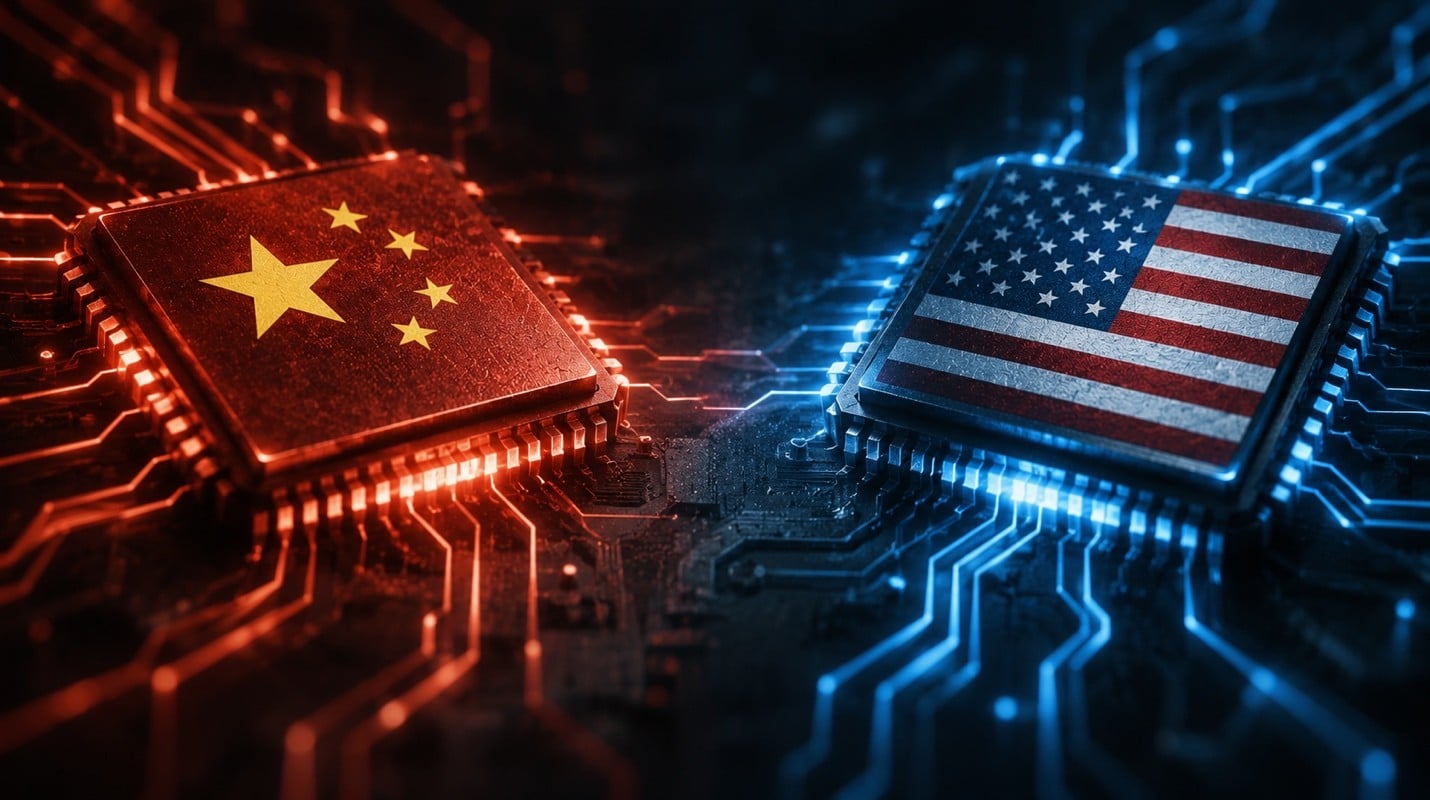
Killer American robots and consequences to investors
By Kara Lilly, CFA
Early in this author’s career as a professional investor, sometime after the global financial crisis tore through the global banking system, another asset market ready to implode—or so she thought. She came across a real estate market buckling under the weight of loans so bad, with problems so obvious, that she reasoned the system should eventually fail just as parts of the American financial system had done only a few years earlier.
But this real estate market wasn’t just any market. It was China’s, and embarrassing public meltdowns of the banking system are not what the Chinese do.
This was the early 2010s. China had spent the years following the financial crisis building at a pace almost without precedent. New cities were rising from farmland seemingly out of nowhere. Apartment towers sprouted toward the sky at a pace that made the great urban expansions of the previous century look quaint by comparison. Local governments borrowed heavily to finance roads, bridges and entire new districts, often relying on land sales and ever-rising property values to keep progress moving.
China was, as Napoleon is said to have predicted two centuries earlier, awakening. And it was discovering an insatiable appetite for concrete, credit and growth.
Soon, however, reports of “ghost cities” began appearing in the Western press. There were forests of residential towers with few lights on at night, shopping centres without shoppers, and roads built for traffic that had yet to arrive. Beneath all of this construction sat loans that were clearly beginning to rot. All the familiar hallmarks of a classic property bubble were there. The error was not in seeing the bubble however, but in assuming that China would eventually have to deal with it in a familiar way.
There is actually a term in psychology for a version of this mistake: projection bias, the tendency to assume that other people will think, behave or respond more or less as we would. Investors sometimes make this mistake with economic systems. We take the rules we know—about markets, capital, incentives, losses and, eventually, consequences—and unconsciously assume that everyone else is playing by them too.
But China had no intention of playing by the rules we knew in the West. A bad loan did not necessarily have to be recognized as a bad loan simply because the underlying borrower could not repay it. As the world’s largest controlled economy, debt could be rolled over, refinanced or moved somewhere less visible. Problems that would demand resolution elsewhere could be swept under the rug.
But this is not a story about China’s property market. This is a story about the AI boom and how it ultimately resolves, a question weighing heavily on investors this week following the Democrats’ midterm victories and the prospect of greater regulation of the American AI industry.
To have that conversation, however, we must talk about Napoleon’s former slumbering giant.
Because once again, investors are looking at an extraordinary capital cycle and asking when the economics will finally impose discipline.
And this time, China is part of the answer.
America leads, for now
In the second half of the 20th century, the world watched one of the greatest capital arms races in history unfold between the United States and the Soviet Union. The competition was martial, technological and ideological, but it was also economic. Vast amounts of capital, scientific talent and industrial capacity were marshalled toward a contest neither side believed it could afford to lose.
More than half a century later, another technological arms race is underway. America, once again, sits on one side of it.
For now, the United States is still the dominant force in frontier artificial intelligence, the industry’s term for the most advanced and capable models. At the centre are OpenAI, maker of ChatGPT, and Anthropic, maker of Claude, with Google’s Gemini behind. According to Menlo Ventures, Anthropic now accounts for roughly 55% of enterprise spending on large language models, OpenAI 31% and Google 9%. Between them, three American companies capture nearly nine out of every ten dollars businesses spend on these models.
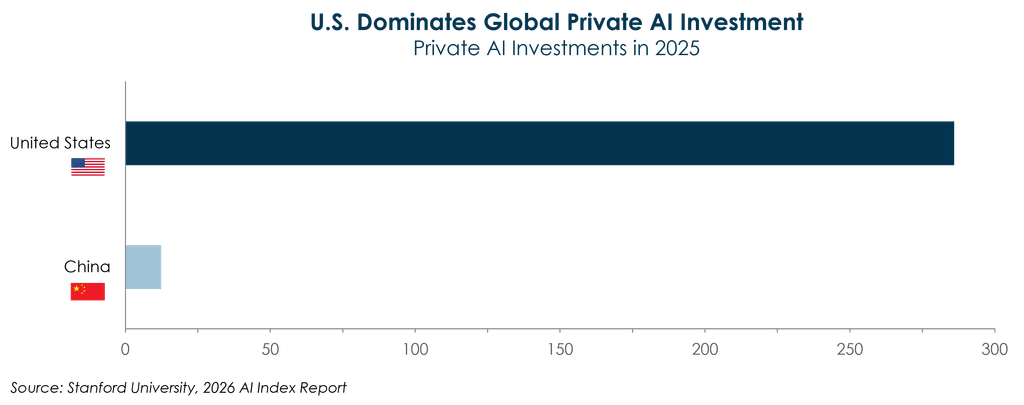
America’s lead also dominates in the private capital being committed to build them. According to Stanford University’s 2026 AI Index Report, the United States accounted for the overwhelming majority of global private AI investment in 2025, attracting approximately $286 billion, more than 23 times China’s $12.4 billion and more than the rest of the world combined. American private AI investment surged 160% from the previous year, compared with an increase of just 32% in China.
Microsoft, Alphabet, Amazon and Meta are collectively spending hundreds of billions of dollars a year on data centres, chips and the infrastructure required to support them. These are all American companies.
For all the talk of a global AI boom, much of the money fueling it is, for now, American. And U.S. companies still lead the way.
But they are not alone.
China is closing the gap
For years, China was treated as a distant second in artificial intelligence: formidable in research and engineering talent, but well behind the United States where it mattered most. As recently as 2023, the best American AI models held enormous leads over their Chinese counterparts on some of the industry’s most important benchmarks.
That gap has since narrowed considerably. Chinese models from DeepSeek, Alibaba and others now compete surprisingly closely with the best American systems, in some cases while using fewer resources and charging users considerably less. Stanford’s 2026 AI Index concluded that the performance gap between the best American and Chinese models had effectively closed.
DeepSeek, a model created by the Chinese artificial intelligence company of the same name, is probably the best example of this shift. Its arrival in early 2025 shocked Silicon Valley because China had produced an AI model capable of competing with leading American models despite operating under constraints designed specifically to prevent it from doing so.
Moreover, China possesses at least one clear advantage over the United States: it can build enormous amounts of physical infrastructure, quickly and relatively cheaply. This matters because, for all the attention paid to models and semiconductors, artificial intelligence is becoming an increasingly physical industry. Data centres have to be built. They have to be filled with equipment, connected to transmission networks and, above all, supplied with enormous amounts of electricity.
China’s advantages here are difficult to overstate. China already produces more than twice as much electricity as the United States and continues to add generating capacity at an extraordinary pace. So far in 2026, it has added an average of roughly 12 gigawatts of solar capacity every month. This sits alongside an enormous domestic manufacturing base and decades of experience building power plants, transmission lines, factories and other large-scale infrastructure.
Now imagine trying to get that much new generating capacity approved, let alone built, every month in the United States. Anywhere.
In short, China operates under a very different set of constraints, and the AI race is increasingly moving into precisely the kinds of things China is very good at building. What’s more, public attitudes towards AI are dramatically different in China than in the United States. Eighty-three per cent of Chinese respondents believe AI products and services offer more benefits than drawbacks. In the United States, only 39% do.
If there will be killer robots, let them be American
Which brings us to the question of the hour. Every investor right now is more or less asking how long the current capital expenditure cycle can last for. To this we ask:
Are the Americans in an AI arms race with China?
Answering this question matters for investors because an arms race would almost certainly distort the normal process of creative destruction within this capital expenditure cycle. Under ordinary circumstances, excessive investment eventually produces disappointing returns, capital becomes more difficult to obtain, and weaker competitors are forced to retreat. An arms race with China complicates this process considerably. Companies may continue investing long after the economics cease to justify it, particularly if governments begin treating technological leadership as a matter of national security rather than commercial advantage, and begin to backstop them.
So, are we? It seems so, at least from the American perspective.
In a recent interview, U.S. Senator Ted Cruz was asked whether the United States should slow the development of increasingly powerful AI.
He responded:
“Here’s the problem. We can’t. That is an impossible endeavor, because you know who’s not pausing? China.”
And then, only partly joking:
“If they’re going to be killer robots, I’d rather they be American killer robots and not Chinese killer robots.”
Cruz is hardly alone in viewing artificial intelligence through the lens of geopolitical competition. Across Washington, the question of AI leadership has increasingly become inseparable from questions of national security, military capability and economic power. The debate is no longer simply about which American company will develop the best model, or whether the extraordinary sums being invested in data centres will ultimately earn an adequate return. It is also about whether the United States can afford to relinquish leadership in a technology that may prove foundational to the next generation of economic and military capabilities.
This framing matters. Once an industry becomes strategically essential, governments become considerably more willing to intervene in its economics, whether through subsidies, preferential procurement, export restrictions or direct support for domestic capacity. The normal discipline imposed by capital markets can become secondary to a much larger political objective.
Of course, with Democrats now controlling Congress, some of this enthusiasm may be tempered by concerns over AI safety and better regulation. But even as those concerns gain prominence, the broader strategic imperative is unlikely to disappear.
For instance, unlike in 2000 when dot-com companies were ultimately allowed to fail, it may become increasingly impossible to let a company like OpenAI collapse.
From the Chinese perspective, this also appears to be an arms race. China is both saying it wants to dominate and is backing these words up.
To begin, Beijing has spent years identifying artificial intelligence as a strategic national priority. Its 2017 development plan established the objective of making China the world’s leading AI innovation centre by 2030. More recently, in August 2025, the Chinese government announced its AI Plus initiative, setting targets for AI integration across major industries and aiming for adoption rates of new-generation intelligent devices and AI agents exceeding 70% by 2027 and 90% by 2030. These are not modest ambitions, nor do they suggest a country content to remain a technological follower.
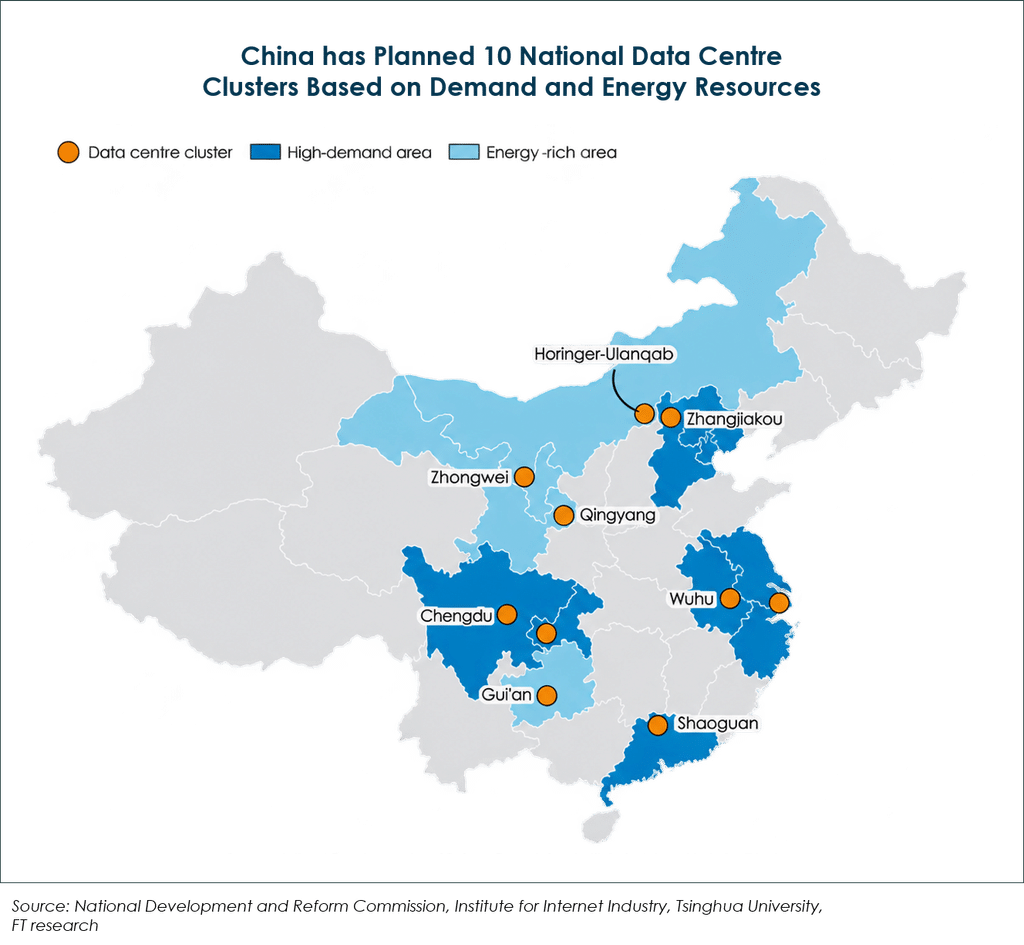
Perhaps more revealing than China’s stated ambitions are its actions. As noted, not only are Chinese companies clearly investing enough R&D to close the gap to their western counterparts, China is building the physical infrastructure to support these ambitions at a remarkable pace. According to one recent FT article, in Inner Mongolia alone, Ulanqab has emerged as a major computing hub, with approximately 15 gigawatts of data centre capacity commitments (that’s roughly 15 nuclear reactors). Companies including Huawei, Alibaba and ByteDance are participating in this expansion, supported by relatively inexpensive electricity, available land and the ability to construct large facilities quickly.
Across the country, new data centres are being constructed alongside enormous investments in electricity generation, transmission networks and domestic semiconductor capabilities.
Yes. This is clearly an arms race.
Economic gravity versus existential necessity
Which brings us back to those empty apartment towers I encountered more than a decade ago, and the insights it gives us on the present moment.
There really were entire communities of empty skyscrapers in China in the early 2010s. The country had aggressively overbuilt, enormous amounts of questionable credit had accumulated underneath it, and many of us criticizing China’s financial system were right about the extent of the problem.
What we did not properly anticipate was what would happen next.
In a Western financial system operating under normal capitalist rules, there eventually comes a point when someone has to take the loss. Property values fall, borrowers can no longer repay their debts and banks are forced to acknowledge that loans once carried at full value are worth considerably less.
China, however, did not need to follow that playbook, and didn’t.
For much of the 2010s, China instead found increasingly creative ways to keep the reckoning at bay. Banks refinanced troubled borrowers rather than forcing them into default. Loans that had clearly deteriorated were rolled over, restructured and shifted into less transparent parts of the financial system rather than recognized immediately as losses (what became known as China’s infamous “shadow banking” system). Local governments, whose finances depended heavily on rising land values, borrowed aggressively through local-government financing vehicles to fund infrastructure and development, selling land to developers and recycling the proceeds back into still more construction. And Chinese households, restricted by capital controls and with relatively few attractive alternatives for their savings, continued pouring money into property.
The result was that China managed to stretch the adjustment over the better part of a decade, repeatedly preventing the normal feedback loop between falling collateral values, bank losses, forced selling and collapsing credit from running its full course.
This kept going and going until eventually, even Beijing decided the system had accumulated too much strain to continue indefinitely.
By 2019 and 2020, Chinese authorities had intensified their efforts to clean up the financial system. In 2020 alone, Chinese banks disposed of an extraordinary RMB 3.02 trillion in non-performing assets through write-offs, transfers, liquidations and other mechanisms, equivalent in value to roughly five times Goldman Sachs’ market capitalization at the end of that year.
The efforts continued, including a sweeping consolidation of China’s banking sector in 2025, when, according to the country’s financial regulator, the number of banking institutions fell by 676 in a single year, from 4,295 at the end of 2024 to 3,619 at the end of 2025.
Authorities pursued mergers, acquisitions and dissolutions to contain financial risks and shore up weaker institutions, while local governments were called upon to provide capital support where necessary.
In sum, rather than allowing the accumulated losses to suddenly overwhelm the banking system, Beijing worked through them piece by piece. There was no Lehman Brothers moment. Markets did not determine who survived, the state did.
Investment takeaways
What can we learn from this period? First, this is how China plays the game. They hold their cards close to their chest, and they play aggressively when they do make a move.
Second, even the Chinese, with all their central control and power, eventually had to submit to the reality of economic gravity.
And third, while they did submit and clean up their mess, they did not do so until they were absolutely forced to.
We should keep all of this in mind in the current moment.
If an AI arms race is indeed brewing between the US and China, it raises the possibility that the normal capital cycle will be distorted. Capital expenditure could continue for longer than the underlying economics would otherwise justify, as companies and governments prioritize strategic advantage over financial returns. The painful reckoning, still the most likely outcome, would be delayed.
There is, however, another important distinction between this cycle and previous investment booms: much of today’s AI spending is being financed by the cash flows and balance sheets of large technology companies, rather than by bank lending. That does not make the capital immune to being wasted, nor does it protect shareholders from substantial losses. But it does change the nature of a potential bust. A collapse in investment returns would not necessarily produce the same kind of banking crisis or credit contagion that has accompanied previous excesses. The losses could be enormous without bringing down the financial system.
In this world, investors will want to avoid owning the riskiest stocks, trading at the wildest valuations, while simultaneously respecting that a real revolution is here.
In the end, economic gravity wins. The trouble is that it doesn’t always operate on an investor’s timetable. It’s worth anticipating this.